a nuffo guide · 12 minute read
How to do a brain dump.
Your head is a great place to have ideas and a terrible place to keep them. A brain dump moves everything onto one page in a few minutes. Here’s how to do one well: what to write, how to sort it, a real before-and-after, 56 prompts for when you go blank, and a free tool that does the sorting for you.
What it is (and isn’t).
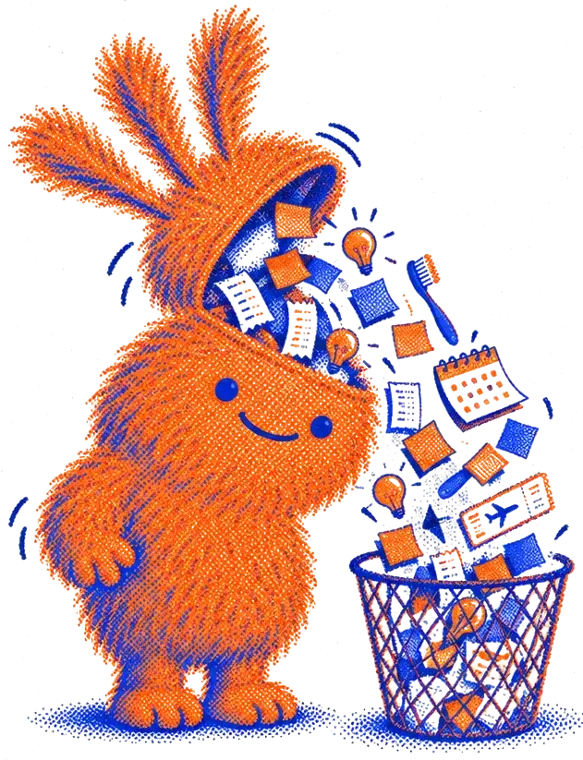
A brain dump is writing down everything on your mind, fast, in any order, without deciding anything yet. Tasks, worries, errands, half-ideas, the birthday next week, the noise the car makes. One thing per line. The point is to get it out of your head and onto something you can look at.
It sounds too simple to need a guide. It mostly is. But a few things separate a dump that helps from one that just makes a longer list.
What a brain dump isn’t
- Not a to-do list. A to-do list is a set of decisions. A brain dump is the raw material for them. Most of what you write won’t happen today, and some of it never will. That’s fine.
- Not journaling. Journaling explores how you feel. A dump just lists what’s there. Feelings can go on the list (“worried about mum’s hip”), but you don’t need to unpack them right now.
- Not a life plan. It’s a snapshot of today’s head. Next week’s will look different.
If you know David Allen’s Getting Things Done, this is close to what he calls a mind sweep: collect everything first, decide later.
When to do one.
- Sunday evening. The week ahead starts to loom around teatime. Ten minutes on paper turns the loom into a list.
- Overwhelmed mornings. You open the laptop and don’t know where to start, so you start everywhere. Five minutes of dumping is quicker than an hour of hopping between tabs.
- Before sleep. When your head starts reciting tomorrow at 11pm, give it a page instead. (There’s a small study on this below.)
- After a holiday or a few sick days. Before you open the inbox, the post or the fridge, dump what you already know is waiting. Then open things.
- Before a big change. New job, a move, a baby, the start of term. Big changes come with a hundred small loose ends.
- When you keep forgetting things. Missed a reply, walked into a room and lost the reason? Often a sign the head is full, not that you’re bad at this.
Why it helps, honestly.
Unfinished things don’t sit quietly. The dentist appointment, the unanswered email, the gift you haven’t bought: each one seems to take a little slice of attention. Here’s what research says about that, with the caveats left in.
Open loops nag (probably)
In the 1920s the psychologist Bluma Zeigarnik reported that people remembered interrupted tasks better than finished ones. The “Zeigarnik effect” has been hard to replicate cleanly since, so treat it as an old, interesting idea rather than a law. The everyday version rings true for most people, though: what’s unfinished tends to resurface.
A plan can quiet the nagging
In a set of experiments published in 2011, E.J. Masicampo and Roy Baumeister found that people reminded of an unfinished goal were more distracted by it during an unrelated task. People who made a specific plan for that goal were not. The goal wasn’t done; it just had a plan. These were lab tasks with university students, not busy lives, but the idea is exactly what a dump plus a sort does: every loose end gets a place and a next step.
A to-do list before bed, in one sleep study
In a 2018 sleep-lab study led by Michael Scullin, 57 young adults spent five minutes before bed writing either a to-do list for the coming days or a list of things they had already done. The to-do group fell asleep faster on average, and the more specific their lists, the faster they fell asleep. It’s one small study of healthy young people over one night, so it’s promising, not proof.
A cousin: expressive writing
Since the 1980s, James Pennebaker and others have studied expressive writing: writing about difficult experiences and feelings, typically for around fifteen minutes a day over a few days. Many studies have linked it to modest benefits, though results vary. It isn’t the same thing as a brain dump, but they’re related: both move what’s inside onto paper. If what’s on your mind is heavy, it deserves more than a line on a list, and sometimes a person to talk to.
Put together: nobody has proven that brain dumps change lives. But writing things down and giving each one a place is cheap, quick, and has decent reasons behind it.
How to do it in 4 steps.
- 1
Dump
Set a timer for five minutes (two on a busy day). Write one thing per line. Don’t sort, don’t judge, don’t fix spelling. Tasks, worries, somedays and half-ideas all go in together. When you slow down, scan the prompts below; something always shakes loose.
Use a verb where you can: “call the dentist”, not “dentist”. Future you will thank you.
- 2
Sort
Go down the list once and give every line a place. Five piles are enough:
- Today: things that really need doing today, or that you’d love to.
- Later: tasks for another day. Add a date if there is one.
- Wishes: someday things. The trip, the book, the pottery class.
- Waits 7 days: big new ideas, like a side project or a hobby that needs kit. Write them down and leave them for a week. If you still want one next Sunday, it’s real. (More on why in shiny object syndrome.)
- Not sure: allowed. Make a small pile and look again next week. One stubborn line shouldn’t hold up the rest.
- 3
Pick three
From the Today pile, choose at most three, and mark the one that matters most as your main win. If Today has eight things, five go to later. That’s not failing, that’s arithmetic. The rule of three explains why three works better than six.
- 4
Let go
Cross out what you can drop. It’s the best part: some things were only on your mind because nobody wrote them down and said “no”. Projects you won’t finish deserve a kind goodbye in the project graveyard, and things you keep saying yes to belong on a not-to-do list.
A real one, before and after.
Here’s a typed ramble from a Sunday evening, exactly as it came out:
ok so. need to reply to Jen about the Thursday deck, still haven’t. car is making that noise again. mum’s birthday is the 14th, get a card, maybe flowers. dentist, been putting that off since spring. renew car insurance, letter says end of month. want to learn Spanish properly before summer. cancel the streaming thing I never watch. bathroom tap drips. should I start a newsletter about the garden? that would be fun. offsite agenda, nobody’s done it. call Sam back. bin bags. tired of feeling behind on everything. book the boiler service before winter.
Split into lines and sorted, it looks like this:
| Thing | Goes to | Why |
|---|---|---|
| Reply to Jen about Thursday’s deck | Today (main win) | Someone’s waiting, and it unblocks the rest of her week too. |
| Call the dentist and book a check-up | Today | A two-minute call that has been nagging since spring. |
| Buy a birthday card for mum (the 14th) | Today | Posting it on time beats finding the perfect one. |
| Call Sam back | Later: tomorrow | Not urgent, but give it a day so it doesn’t drift. |
| Draft the offsite agenda | Later: Tuesday | Needs an hour of focus, not a rushed Sunday. |
| Renew the car insurance | Later: by the 30th | The letter has a date. Use it. |
| Get the car noise checked | Later: this week | Book it before it becomes a bigger noise. |
| Book the boiler service | Later: this month | Before winter, not before Monday. |
| Fix the dripping tap | Later | Annoying, not urgent. |
| Cancel the streaming subscription | Later | Five minutes, whenever the laptop is open anyway. |
| Buy bin bags | Later: shopping list | Errands go where errands live. |
| Learn Spanish before summer | Wishes | A real wish. It needs a plan, not a Monday. |
| Start a newsletter about the garden | Waits 7 days | A big new idea. If it still sounds fun next Sunday, it can become a project. |
| Flowers for mum too? | Not sure | Depends on whether you’ll see her. Fine to decide next week. |
| “Tired of feeling behind on everything” | Not a task | A feeling, worth noticing. The list above is the answer to it. |
Fifteen lines. Three for today, eight for later (most with a date), one wish, one idea cooling for a week, one maybe, and one feeling. “Behind on everything” turned out to be about a dozen specific things, which is a much smaller number than everything.
Paper, phone or voice?
Paper
No notifications, nothing to open, and crossing things out is deeply satisfying. Good in bed and on trains. The catch: it stays on the paper, so copy the sorted result somewhere you’ll see it. The free three-things planner has a box for exactly that.
Phone or laptop
Always with you, searchable, and easy to paste into a sorter. The catch: the phone is also where the distractions live. Put it on airplane mode for five minutes, dump, then switch it back.
Voice
The fastest of the three. Works while walking, cooking or driving, and helps if writing feels like a barrier. The catch: a voice memo is one long ramble, so it needs transcribing and splitting into separate things before you can sort it.
The rule for all three: use whichever you’ll actually use, and keep the result in one place you trust. A dump spread across six sticky notes is the same mess, in more places. Once you’ve picked your three, putting them on a lock-screen wallpaper keeps them where you look all day.
56 prompts by life area.
Use these when you slow down, not before you start. Read them fast, write whatever comes up, skip what doesn’t apply. Most people find their stragglers in two or three areas, not all ten.
Work
- What’s due this week?
- Who am I waiting on, and who’s waiting on me?
- Which email have I been avoiding?
- What meeting needs preparing?
- What does my boss or a client keep asking about?
- What’s half-finished on my desk or desktop?
Home
- What’s broken, dripping or squeaking?
- What needs buying before we run out?
- Which room is quietly bothering me?
- Any bins, plants or pets on a schedule?
- What’s piling up by the door?
- Anything to return, repair or give away?
People
- Whose birthday or anniversary is coming up?
- Who do I owe a reply, a call or a thank-you?
- Who haven’t I seen in too long?
- Any plans to confirm or cancel?
- What do the kids, my parents or my partner need from me?
- Did I promise anyone anything, even casually?
Money & admin
- Which bills or renewals are coming up?
- Any forms, taxes or insurance to sort?
- Subscriptions I meant to cancel?
- Receipts, refunds or expenses to chase?
- Documents that expire soon (passport, licence, ID)?
- Anything to sign, scan or file?
Health & appointments
- Any appointments to book: doctor, dentist, eyes?
- Prescriptions to refill?
- A check-up I’ve been putting off?
- A vet visit or vaccination for a pet?
- Letters or results I still need to read?
Body & rest
- What would help me sleep better this week?
- When am I moving, walking or playing?
- What am I eating that I’d like to change?
- When is my next proper day off?
- What has my body been asking for lately?
Fun
- What would make a free Saturday great?
- Which restaurant have I been meaning to try?
- Any tickets to buy before they sell out?
- Which books, films or shows keep coming up?
- Who would I like to have dinner with soon?
Projects
- What are my current projects, honestly?
- What’s the next small step for each?
- Which project am I secretly avoiding?
- Which one could I put down, with a note?
- What’s nearly done and just needs finishing?
- What’s the new idea I keep thinking about?
Someday
- Where do I want to go?
- What do I want to learn?
- What would I try if it were easy?
- What do I want more of next year?
- What have I said “one day” about more than twice?
The rest
- What’s the thing I keep remembering at 2am?
- What am I worried I’ll forget?
- What’s bugging me that I haven’t named yet?
- What am I waiting to hear back about?
- What’s one thing I could let go of entirely?
- Anything else rattling around?
Sort yours: free tool.
Paste your brain dump below. Nuffo splits it into separate things, picks three for today and files the rest: later, wishes, or the 7-day wait. Nothing is stored and you don’t need an account. (It’s also on its own page: the brain-dump sorter.)
Common mistakes, and the fixes.
1. Sorting while you dump
You write one line, then stop to decide whether it’s today or Thursday, and the flow is gone. Fix: two passes. Dump with a timer first, sort after. Deciding is a different job.
2. Turning the dump into a to-do list of 40
The dump is an inventory, not a promise. Treating every line as something to do today is how a calming exercise becomes a stressful one. Fix: only three things come out as today. Everything else gets a place, and a place is enough.
3. Judging what comes out
“I should have booked that months ago.” Maybe, but the commentary doesn’t help you book it. Fix: write the thing, not the verdict. Late things don’t need guilt, they need a date.
4. Writing vague lines
“Work stuff” and “house” are moods, not tasks. They’ll nag you just as much on paper. Fix: a verb and a thing: “send Jen the deck”, “fix the tap”. If you can’t name the verb yet, write “decide what to do about the house”. That’s a task too.
5. Starting every idea that appears
A good dump surfaces exciting new ideas, and the exciting ones are the hardest to leave alone. Fix: big new ideas wait seven days. Most cool down on their own; the ones that don’t were worth waiting for.
6. Doing it once and never again
One dump feels great. Then the head fills up again, because life keeps happening. Fix: a small regular rhythm (below), and one trusted place for the result, so next week you add to it instead of starting over.
How often: weekly and daily.
A full dump once a week, a tiny one on busy mornings, and quick captures whenever something pops up. That’s the whole system.
The 5-minute weekly ritual
Sunday evening suits most people, but any calm half-hour at the edge of the week works.
- Minutes 0–2, dump. Start with what’s left from last week, then scan the prompts.
- Minutes 2–4, sort. Five piles. Look at last week’s cooling ideas: still want them? Then they can move on. Not really? Let them go.
- Minute 4–5, pick Monday’s three. Glance at the week’s fixed things, choose three for Monday, and close the notebook.
Prefer it on paper? The free weekly planner has room for the week’s projects and three things a day.
The 2-minute daily version
- One minute: what’s on my mind this morning? Write it down, one line each.
- One minute: pick three for today from that and your later list. Done.
The trick isn’t the writing. It’s trusting that what you wrote down will still be there when you need it, so your head can stop holding it. Then pick three, do them, and call it a day. Three things is enough. go live a little.
Quick answers
What is a brain dump?
Writing down everything on your mind, quickly and without sorting, so it lives on a page instead of in your head. Tasks, worries, errands, ideas and somedays, all of it, in any order. Deciding comes afterwards.
How do you do a brain dump?
Four steps. Dump: set a timer and write one thing per line without sorting or judging. Sort: give each line a place (today, later, wishes, a 7-day wait for big new ideas, or not sure). Pick three: choose at most three things for today. Let go: cross out what you can drop.
How long should a brain dump take?
Five to ten minutes for a full weekly one, two minutes for a daily one. Set a timer and stop when things stop coming. It’s a clear-out, not an essay.
What is the difference between a brain dump and journaling?
Journaling explores what you think and feel, usually in sentences. A brain dump is a quick inventory of what’s on your mind, one line each, so you can sort it. Feelings can go on the list, but you don’t unpack them there. Plenty of people do both.
What should I do with a brain dump afterwards?
Sort it the same day. Pick at most three things for today, move other tasks to a later list with dates where there are dates, put somedays on a wish list, let big new ideas wait a week, and cross out anything you can let go. Keep the result in one place you trust.
How often should I do a brain dump?
A full one once a week (Sunday evening works well for many people) and a two-minute version on mornings that feel busy. Skipping a week costs nothing. There’s nothing to catch up on: just do the next one.
Is a brain dump good for ADHD?
It isn’t a treatment and we can’t make medical claims. Some people with busy, jumpy heads find these help: talk instead of typing, keep it short with a timer, sort in a separate step, keep the sorted list where you can see it, and pick fewer things, not more. If ADHD is affecting your life, a doctor or specialist is the right person to talk to.
Should I brain dump on paper or on my phone?
Whichever you’ll actually use. Paper is calm and satisfying to cross out. A phone is always with you and easy to paste into a sorter. Voice is fastest if writing feels like a chore. What matters is that the result ends up in one trusted place.
Does a brain dump actually help?
It helps many people feel calmer, and there are decent reasons why. Lab studies suggest that making a concrete plan for an unfinished goal can quiet intrusive thoughts about it, and one small sleep study found that writing a specific to-do list before bed helped people fall asleep faster. Nobody has proven it changes lives, but it’s cheap and quick to try.
Three things is enough.
In Nuffo, you dump anything, any time: typed, pasted, by voice or by email. It sorts it for you and suggests three things each morning. Free.
Start free